
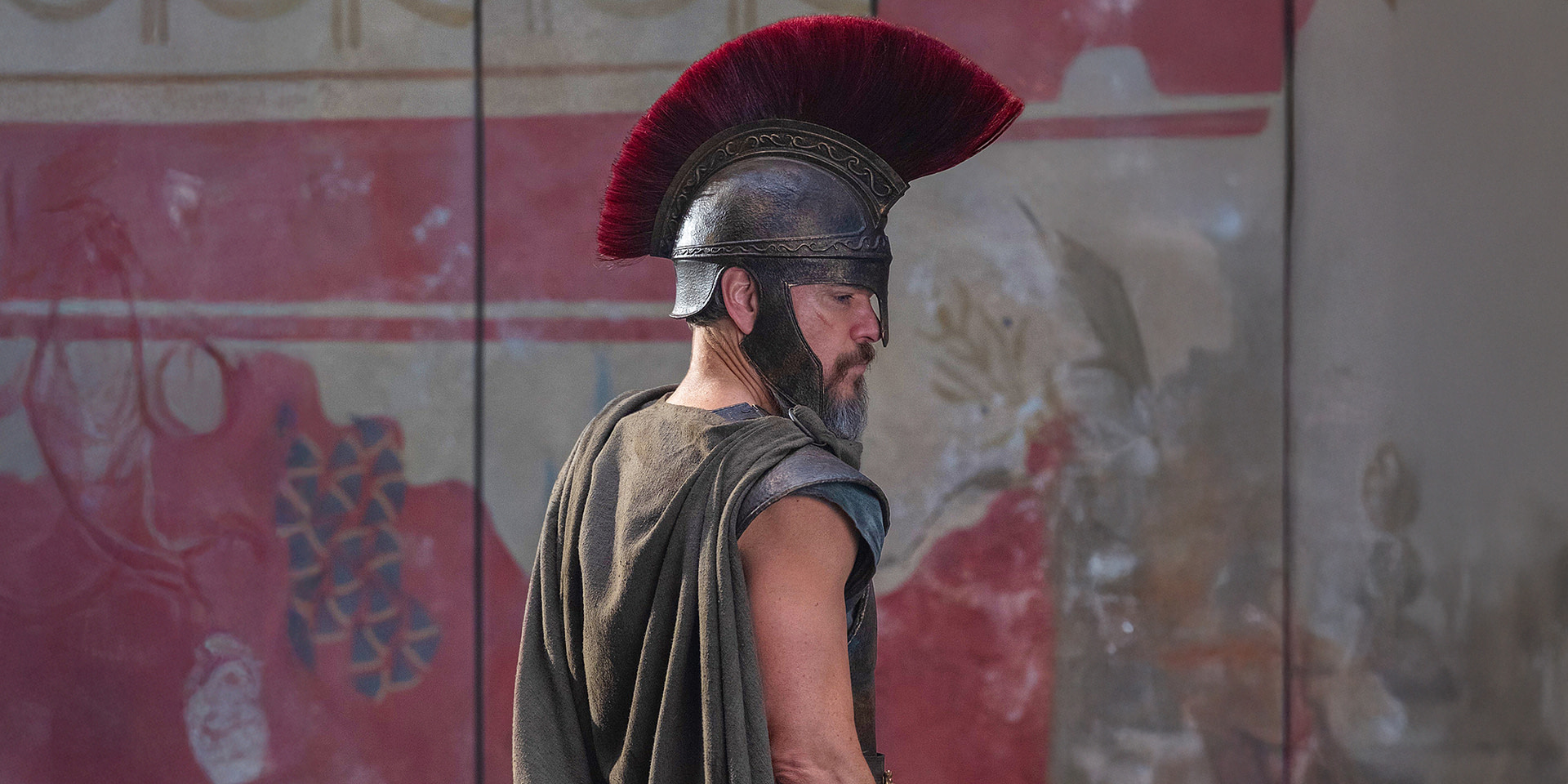

A reflection for the release of Christopher Nolan’s The Odyssey
This past week, one of the oldest stories in the world arrived on the biggest screens we build. Christopher Nolan’s The Odyssey opened in theaters last Friday, and for the next month or so, a poem nearly three thousand years old will be the most talked-about story in America. Odysseus, the war-weary king of Ithaca, will once again try to get home.
Some of us will go see it. Some of us will wonder if we should (it holds an R rating for violence). And a few of us will wonder whether a pagan epic full of vengeful gods, monsters, and morally complicated heroes has anything to offer a follower of Jesus in the 21st century.
I want to recommend that it does — not because it is equivalent to the epics found in the Bible, or because Homer got everything right, but because he got the questions right — and because seeing where his answers fail is one of the clearest ways to see why the Gospel was such good news to the Greeks, and why it is such good news for us today.
The church has been here before
Christians reading pagan classics is not a modern compromise, it has been recommended as far back as the events of the New Testament. When Paul stood on Mars Hill in Athens, he didn’t quote Moses to the Greeks; he quoted their own poets: “For in Him we live and move and have our being” (Acts 17:28). He knew their literature well enough to find the true thing buried inside it and turn it toward Christ – and he knew this would have a stronger effect than preaching unknown patriarchs and unknown symbols to a cultured people.
St. Augustine called this “plundering the Egyptians” — taking the gold of pagan learning and putting it to holy use, the way Israel carried Egypt’s treasure into the wilderness. Basil the Great wrote an entire address to young Christians on how to read Greek literature: “take the honey”, he said, “and leave the thorns”. The classics were the church’s schoolroom for centuries. Until more recent times, we did not inherit a church afraid of Homer. We inherited a faith that read him carefully.
A world our Bible knows
Here is something that surprises people: Homer and the Old Testament are next-door neighbors. The world of The Odyssey — the Late Bronze Age, roughly the twelfth century before Christ — overlaps the world of the judges and the early kings of Israel. Troy fell within a few generations of Deborah and Gideon. These stories grew up on opposite shores of the same sea at the same time.
The Odyssey turns on hospitality — xenia, the sacred obligation to welcome the stranger, because the stranger might be a god in disguise. Read that, and then read Abraham running to greet three travelers at the oaks of Mamre (Genesis 18), or the writer of Hebrews reminding us that some have entertained angels without knowing it. Both worlds understood a cultural value that we moderns have nearly forgotten: how you treat the stranger at your door reveals who you actually worship.
Both are stories carried by memory and spoken word before they were carried by ink. They were recited around fires, sung at feasts, passed from mouth to ear by people who believed the past made claims on the present. Both The Odyssey and the Bible are built on the same ancient shape taken by all humanity: exile and return. A man far from home, longing for it, tested on the way. That shape is Odysseus’s and ours — Eden lost, Babylon endured, the long road back. Scripture is, among other things, the story of a people trying to get home. Homer knew that ache. His people had just become disconnected from the address.


The gods Homer gave us — and the God who came to us
But here is where The Odyssey becomes most useful to a Christian: not where it agrees with Scripture, but where it doesn’t.
The gods of Homer are humans (or fallen angels) written large. Zeus schemes. Poseidon holds grudges for a decade over a wounded son. Athena helps Odysseus not because he is good but because he is clever — because his deceptions delight her. The Greek pantheon is not a moral standard above the world; it is the world’s appetites given thunderbolts and shapeshifting abilities.
The virtues that world produces are inverted from everything Jesus taught. The highest good in Homer’s universe is kleos; glory, the fame won through violence, your name outliving your body. The prized skill is metis, cunning, a beautiful lie. Odysseus is introduced in the poem’s very first line as “the man of many turns.” His signature virtue is cleverness (see, deception). Strength takes; weakness is shameful; mercy is optional; and when Odysseus finally reaches home, the story ends not in forgiveness but in a hall full of slaughtered suitors.
Now set that beside the Gospel, shared to the Greeks as good news and the story of the “unknown god” 900 years later. Christ, “being in very nature God, did not consider equality with God something to be used to His own advantage; rather, He made Himself nothing” (Philippians 2:6–7). The Greek gods demand placation; the living God descends and serves. Homer’s heroes climb toward glory over the bodies of their enemies; Jesus tells us the last will be first, and then dies for His enemies. The pagan world called humility weakness and mercy folly. Christianity took the whole scale of virtue and turned it right side up — which is why the Roman world found the Gospel not merely new but scandalous – a name even used for Jesus. You cannot fully feel that scandal until you have sat inside the world it overturned. One we have forgotten in our era of blessing. Spending time with Homer lets you sit back there.
What Homer still gets right
And yet, we leave room for the honey. Odysseus weeps on Calypso’s island, offered immortality itself, and refuses it because it isn’t home. That is not a pagan feeling. That is the human condition. “He has also set eternity in the human heart” (Ecclesiastes 3:11), and Homer felt eternity pressing on him even if he couldn’t name it. St. Augustine would say it plainly centuries later: “our hearts are restless until they rest in God”.
Penelope’s decades of faithfulness while the world tells her to give up. Telemachus growing into a son worthy of his father. The suspicion, humming under every line, that the journey is forming the man. That the long way home is not a delay in the story but the story itself. These are true things, and truth is God’s wherever we find it.
So go see it
If you feel it is appropriate for you to take in an R-Rated film, go see the movie – but better yet, read the poem — with your kids if they’re old enough, because they will meet Odysseus in a classroom eventually and they should meet him first with you, holding the story up to the light of Scripture together. Ask the questions Homer asks: What is home? What is a hero? What do the gods want? Then notice, with fresh gratitude, that the answers we’ve been given are better than anything his home in Ithaca ever offered.
Odysseus sailed ten years toward a kingdom he had to take back by force. We are walking toward a Kingdom that was won for us, by a King who left home so that we could finally arrive.
For the long obedience in the same direction,
Rich


